
TOPIC 4. WRITING INTRODUCTION AND FORMULATING RESEARCH QUESTIONS
INTRODUCTION
A. Learning Objectives:
After completing this session, students are expected to be able to:
- Explain the concepts and functions of Swales’ rhetorical Moves (establishing a territory, establishing a niche, and occupying the niche) in scientific article introductions.
- Apply Swales’ Moves to draft introduction paragraphs, integrating relevant theories and previous studies to support their arguments.
- Manage a reference library using reference management tool for academic writing purposes.
- Evaluate and revise their own drafts and peer drafts through structured peer review, focusing on rhetorical structure, academic writing conventions, and academic and digital ethics.
B. Skill Focus of This Session
This session emphasizes the rhetorical construction of the introduction section in scientific articles, particularly through the application of Swales’ CARS (Create A Research Space) model. Students progress from conceptual understanding to guided application and critical evaluation.
C. Micro Skills Developed
In this session, students will develop the ability to:
- distinguish the three core Moves in Swales’ introduction model and explain their communicative purposes,
- identify linguistic markers signaling each Move (e.g., centrality claims, gap statements, research purposes),
- synthesize relevant theories and previous empirical studies to support the establishment of a research territory and niche,
- use reference management tools (e.g., Mendeley, Zotero, or EndNote) to insert citations and generate bibliographies accurately,
- apply structured peer review criteria to identify strengths and weaknesses in introduction drafts.
These micro skills strengthen students’ technical control over rhetorical structure and citation practices.
D. Macro Skills Developed
Building upon these abilities, students will develop the capacity to:
- construct a persuasive and academically sound research introduction,
- position their research within ongoing scholarly conversations,
- demonstrate ethical academic practices in citation, paraphrasing, and digital tool usage,
- engage in reflective revision based on peer and self-evaluation.
Through these macro skills, students move beyond understanding rhetorical patterns toward strategically employing them to establish their scholarly identity as emerging researchers.
BRAINSTORMING (YIELD)
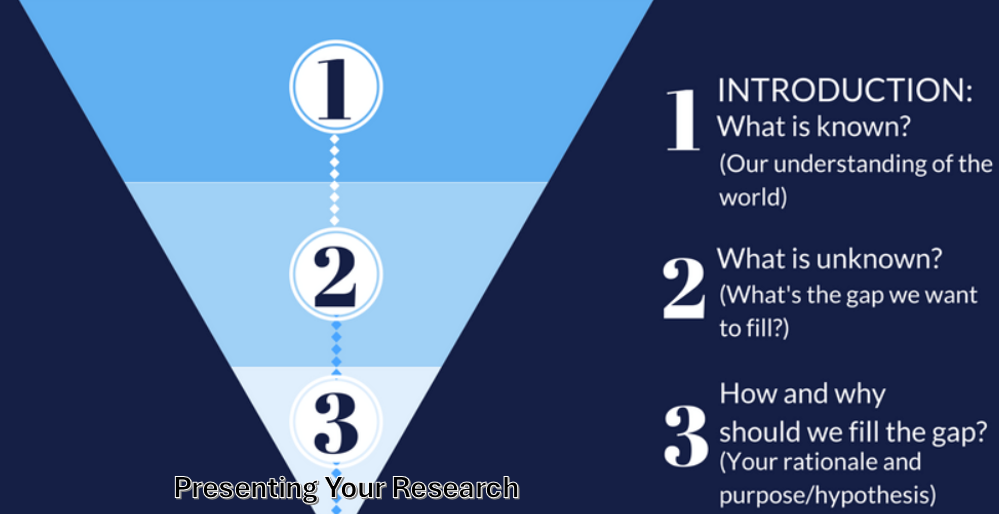
When writing an introduction for a research article, it is important to guide the reader step by step. According to Swales’ CARS model, the introduction usually follows three main moves:
- What is known? – Begin by presenting what is already understood in the field or the general background of the topic.
- What is unknown? – Then highlight the gap or problem that has not yet been fully addressed by previous research.
- How and why should we fill the gap? – Finally, explain the purpose of the study, the rationale, or the hypothesis that will guide your research.
This logical flow helps readers clearly see the importance of the study and understand how your research contributes to the field. To better understand how an introduction should be structured, let’s look at a simple model that illustrates the three essential moves in writing an introduction.
A. Worksheet 4.1 Match the Paragraph with the Correct Move
Instructions:
- Read the following short introduction paragraphs (1–4).
- Each paragraph represents one of the rhetorical Moves in Swales’ CARS (Create A Research Space) model for writing introductions.
- Move 1: Establishing a Territory
- Move 2: Establishing a Niche
- Move 3: Occupying the Niche
- Match each paragraph (1–4) with the correct Move.
| No | Paragraph | Move |
| 1 | 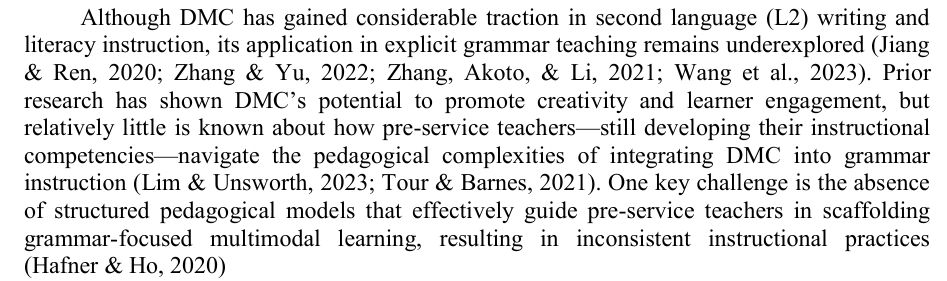 |
|
| 2 | 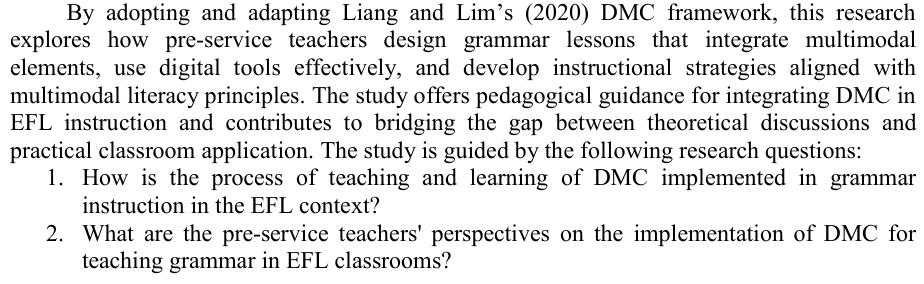 |
|
| 3 | 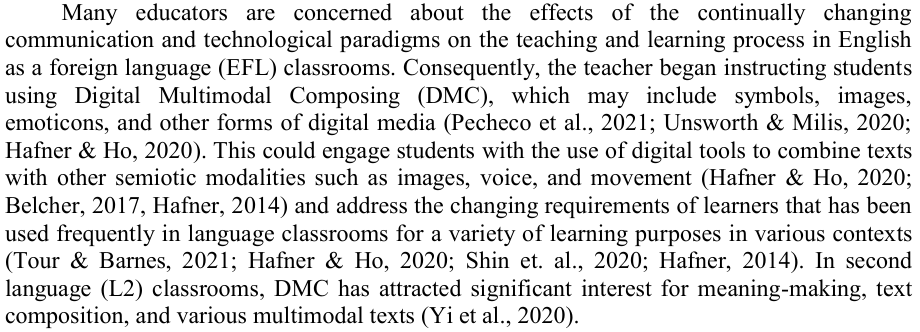 |
|
| 4 | 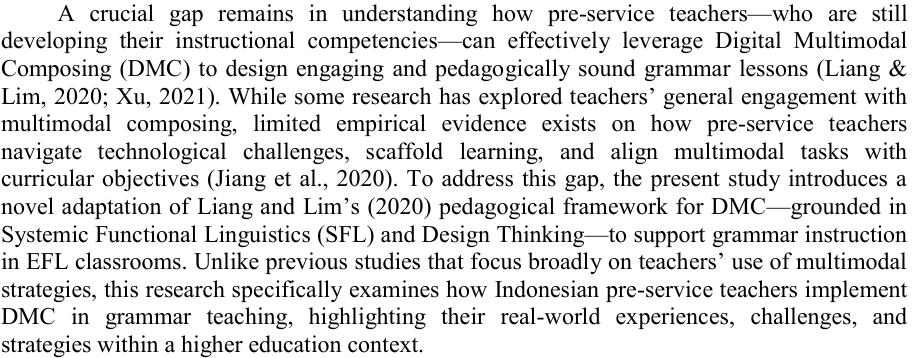 |
INDIVIDUAL EXPLORATION (YIELD)
In this stage, students begin to develop their revised research outline that has been improved based on feedback from peers and the lecturer in the previous session. Each student expands the key points from their revised outline into connected sentences and paragraphs, guided by Swales’ CARS model. They are expected to:
- Move 1 (Establishing a Territory): Write background information and general topic statements to introduce the research area, supported by relevant theories and previous studies.
- Move 2 (Establishing a Niche): Highlight research gaps, weaknesses, or problems in existing studies to justify the need for their research.
- Move 3 (Occupying the Niche): Present their research aim, questions, and contribution to the field.
Before writing your own Introduction section, it is important to first manage your references properly. Academic writing requires accurate citation practices to support arguments, acknowledge previous studies, and avoid plagiarism. One practical way to manage references efficiently is by using Mendeley, a reference management tool widely used in academic research.
A. Stages in Using Mendeley to Support Academic Writing
- Create a Mendeley Account
Visit the Mendeley website and create an account using your email address. This account allows you to store and synchronize your references across devices. - Install Mendeley and the Word Plugin
Download Mendeley Reference Manager and install the Mendeley Cite plugin for Microsoft Word. The plugin enables you to insert in-text citations and generate reference lists directly while writing. - Add Journal Articles to Mendeley
You can add references by uploading PDF journal articles, importing files from academic databases, or entering bibliographic information manually. Always check and correct the metadata to ensure accuracy. - Organize Your References
Create folders based on your research topic or article section. Use notes or tags to highlight key ideas, research gaps, or relevant theories that will support your Introduction. - Insert In-Text Citations
While drafting your Introduction, place the cursor where a citation is needed and insert references using Mendeley Cite. The citation will appear automatically according to the selected style. - Generate the Reference List
At the end of your manuscript, use Mendeley to generate a reference list automatically. Any changes to in-text citations will be updated in the bibliography. - Follow Ethical Citation Practices
Use Mendeley as a support tool, not as a substitute for reading original sources. Ensure that all cited works are relevant, accurately represented, and listed in the reference section.
B. Worksheet 4.2 – Developing Introduction Paragraphs Using Swales’ Moves (1–3)
Develop your outline into paragraph drafts for the Introduction section, using Swales’ CARS Model (Move 1–3). Each paragraph should be supported by relevant theories and previous studies, with proper citations. At the end, formulate your research question(s) clearly.
Instruction:
- Complete the table by drafting 3–4 Introduction paragraphs based on Swales’ Moves (1–3).
- Ensure each paragraph aligns with the intended rhetorical Move.
- Support each paragraph with at least 2–3 scholarly sources.
- Manage in-text citations and references using Mendeley, and write full references in APA 7th edition style.
- If generative AI is used at any stage (e.g., idea refinement or language support), write a brief AI use statement specifying how the tool was used and affirming that the content, analysis, and interpretation remain your own.
Guideline Table
| Swales Move | Topic of Paragraph | Students Paragraph
(Write in full sentences) |
| Move 1:
Establishing a Territory |
Background of the study | |
| Move 2: Establishing a Niche | Research gap or problem
(limitations in previous studies) |
|
| Move 3: Occupying the Niche | Purpose of the study (aims, research questions) | |
| References
(APA Style) |
List all cited sources in APA 7th edition format generated and checked using Mendeley. | |
| AI Use Statement | If generative AI is used (e.g., for language refinement or idea clarification), write a brief AI use statement describing how the tool was used and confirming that the analysis and content are the student’s own. | |
- This topic has 64 replies, 22 voices, and was last updated 3 months, 3 weeks ago by
.


- You must be logged in to reply to this topic.
SHARING AND DISCUSSION (TRANSFORM)
In this stage, students engage in structured peer review by exchanging their drafted Introduction sections developed during the Individual Exploration phase. The primary purpose of this stage is critical evaluation, not revision, allowing students to examine the rhetorical effectiveness, ethical integrity, and academic appropriateness of peers’ drafts through guided discussion.
Each student reviews a peer’s introduction systematically using Swales’ CARS model, focusing on the realization of rhetorical moves and their communicative purposes:
- Move 1 – Establishing a Territory
Does the introduction clearly present the research field and justify its significance through relevant and credible literature? - Move 2 – Establishing a Niche
Does the writer identify a clear research gap, limitation, controversy, or underexplored issue in previous studies? - Move 3 – Occupying the Niche
Does the introduction explicitly state the research purpose, significance, and research questions or objectives in a logical and coherent manner?
Peer review activities in this stage are guided by an Integrated Peer Review Rubric, which evaluates rhetorical structure, academic ethics, and digital ethics simultaneously. The rubric helps students move beyond surface-level feedback by encouraging them to assess originality, citation practices, ethical use of digital tools, and alignment with disciplinary conventions.
A. Worksheet 4.3 – Peer Review (Transform Stage)
- This topic has 0 replies, 1 voice, and was last updated 1 year ago by
.
- You must be logged in to reply to this topic.
DRAFTING AND REFINING (HONE)
In this stage, students move from peer-review interaction to individual refinement of their introduction section. After participating in the Sharing and Discussion (Transform) stage—where drafts were reviewed using an integrated peer review rubric—students now focus on revising and improving their own writing based on the feedback received.
The Hone Stage emphasizes purposeful revision, not merely surface-level editing. Students are expected to strengthen rhetorical organization, enhance clarity and coherence, and ensure ethical and academic appropriateness in their revised drafts. Revision decisions should be selective and reflective, demonstrating students’ ability to interpret feedback critically and apply it meaningfully to improve the quality of their academic writing.
At this stage, students are expected to:
- Integrate relevant feedback from peers and the lecturer based on the peer review rubric.
- Refine the logical flow and rhetorical structure of the introduction by strengthening Move 1 (Establishing a Territory), Move 2 (Establishing a Niche), and Move 3 (Occupying the Niche) in line with Swales’ CARS model.
- Ensure that research purposes and research questions are clearly and explicitly stated in Move 3.
- Review and revise citation practices, paraphrasing, and references to ensure compliance with APA 7th edition and principles of academic ethics.
- Improve academic writing quality by enhancing grammatical accuracy, formal academic style, and clarity of argumentation.
- Reflect on the responsible use of digital tools during the revision process in accordance with digital ethics guidelines.
A. Worksheet 4.4
After completing the revision, students are required to upload their revised introduction section draft to the QuiryThink platform.
Authentication required to view this assignment.