
TOPIC 6. WRITING FINDINGS AND DISCUSSION
INTRODUCTION
A. Learning Objectives
After completing this session, students are expected to be able to:
- Identify common typologies and communicative purposes of Findings and Discussion sections in research articles.
- Organize and present research data effectively using tables, charts, and digital visualizations to support rhetorical meanings.
- Apply Yang and Allison’s (2003) rhetorical move framework to draft coherent and well-structured Findings and Discussion sections.
- Evaluate and revise their own drafts and peer drafts through structured peer review, focusing on rhetorical structure, academic writing conventions, and academic and digital ethics.
B. Skill Focus of This Session
This session emphasizes the rhetorical construction of the Findings and Discussion sections in research articles, particularly through the application of Yang and Allison’s (2003) rhetorical move framework. Students progress from recognizing typologies and communicative purposes to drafting, evaluating, and ethically revising data-driven academic texts.
C. Micro Skills Developed
In this session, students will develop the ability to:
- identify common rhetorical moves and communicative purposes in Findings and Discussion sections,
- distinguish between reporting results (Findings) and interpreting results (Discussion) based on rhetorical functions,
- organize quantitative and qualitative research data logically and meaningfully,
- present data using tables, charts, and digital visualizations that accurately support rhetorical claims,
- apply Yang and Allison’s move framework to draft coherent Findings and Discussion paragraphs,
- integrate visual data and textual explanation ethically and responsibly,
- apply structured peer review criteria to evaluate clarity, coherence, rhetorical completeness, and ethical data presentation.
These micro skills strengthen students’ control over data presentation, rhetorical interpretation, and alignment between evidence and claims.
D. Macro Skills Developed
Building upon these abilities, students will develop the capacity to:
- construct analytically sound and rhetorically effective Findings and Discussion sections,
- interpret research results critically and connect them to existing theories and previous studies,
- demonstrate academic integrity in data reporting, interpretation, and use of digital visualization tools,
- engage in reflective revision based on peer feedback and rubric-guided evaluation,
- position research findings within broader disciplinary conversations in a clear and ethical manner.
Through these macro skills, students move beyond simply reporting results toward critical interpretation and scholarly argumentation, strengthening their academic voice and research credibility.
BRAINSTORMING (YIELD)
Specifically, the Findings and Discussion section comprises four main rhetorical moves: (1) providing background information, (2) reporting results, (3) summarizing results, and (4) commenting on results. According to Stoller and Robinson (2013), there are three common typologies or generic structures of the findings and discussion section of a research article. Table 6 displays the typologies.
Table 6. Typologies of Research Article Findings and Discussion Section
| Type | Description (Flow of information) |
| Blocked | [Findings 1, Findings 2] [Discussion 1, Discussion 2] |
| Iterative | [Findings 1, Discussion 1] [Findings 2, Discussion 2] |
| Integrated | Not orderly organized |
Each typology determines how the rhetorical structure is organized. The blocked typology first presents a detailed description and explanation of the findings, followed by a separate discussion section where the authors interpret the results, compare them with previous studies, and explain any expected or unexpected outcomes. In contrast, the iterative typology integrates the findings and discussion, requiring authors to not only report the results but also critically analyze them immediately after presentation. The integrated typology, being the most randomized form of the Findings & Discussion (F&D) section, can make it difficult to distinguish between the findings and discussion elements.
A. Worksheet 6.1- Identifying the Typology of Findings & Discussion (F&D)
Instructions:
- Open each journal link provided in Column Journal Article Link.
- Carefully read the Findings & Discussion (F&D) section of each article.
- Identify the typology used in the F&D section:
- Briefly explain your reasoning for choosing that typology based on the structure and flow of the F&D section.
Table for Student Response
| No | Journal Article Link | Identified Typology |
| 1 | https://ejournal.unib.ac.id/JEET/article/view/29097 | Blocked Typology |
| 2 | https://www.sdgsreview.org/LifestyleJournal/article/view/5562/2601 | |
| 3 | http://www.ejournal.stkipsiliwangi.ac.id/index.php/p2m/article/view/181 | |
| 4 | https://eric.ed.gov/?id=EJ1304494 | |
| 5 | http://www.e-journal.stkipsiliwangi.ac.id/index.php/p2m/article/view/632 |

INDIVIDUAL EXPLORATION (YIELD)
Structural Moves in Findings and Discussion Section
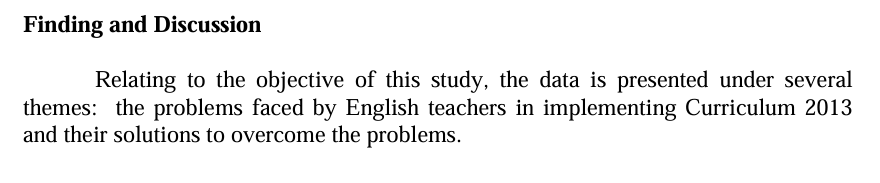
In academic writing, particularly in research articles, the Findings and Discussion section plays a crucial role in presenting and interpreting the results of a study. This section not only reports what was discovered but also provides context, identifies patterns, evaluates the significance of the findings, and draws implications for practice or further research. To guide writers in structuring this section effectively, Yang and Allison (2003) proposed a series of structural moves that organize the presentation and discussion of results in a logical and coherent manner. The following outlines these seven moves, providing both their purpose and illustrative examples.
- Move 1: Background Information. It serves to provide context for the data presented, such as explaining the focus of the study or the research questions, which helps readers interpret the results later. For example:
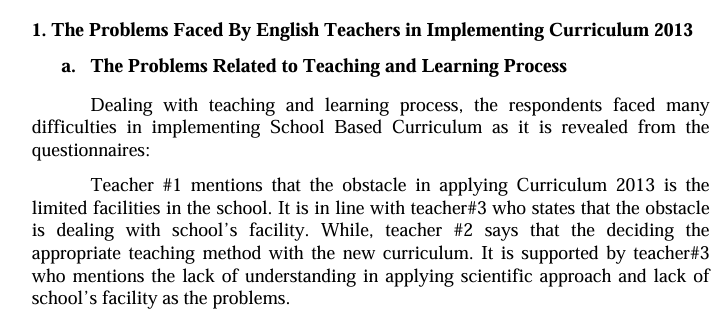
“This section presents the challenges faced by English teachers in primary schools under the Merdeka Curriculum.” - Move 2: Report Results. It systematically presents the research findings, often using tables, graphs, or relevant respondent quotations, focusing on factual reporting without interpretation. Example sentence:
“Internal challenges include teachers’ qualifications, students’ limited vocabulary, and low motivation, as summarized in Table 2.” - Move 3: Summarise Results. It identifies patterns, trends, or key categories to provide a brief summary of the reported results. For instance:
“Overall, internal challenges focus on teacher quality and student motivation, while external challenges relate to curriculum support and school facilities.” - Move 4: Comment on Results. This move consists of four main steps:
- Step 1 Interpreting results
- Step 2 Comparing results with the previous literature
- Step 3 Accounting for results
- Step 4 Evaluating results
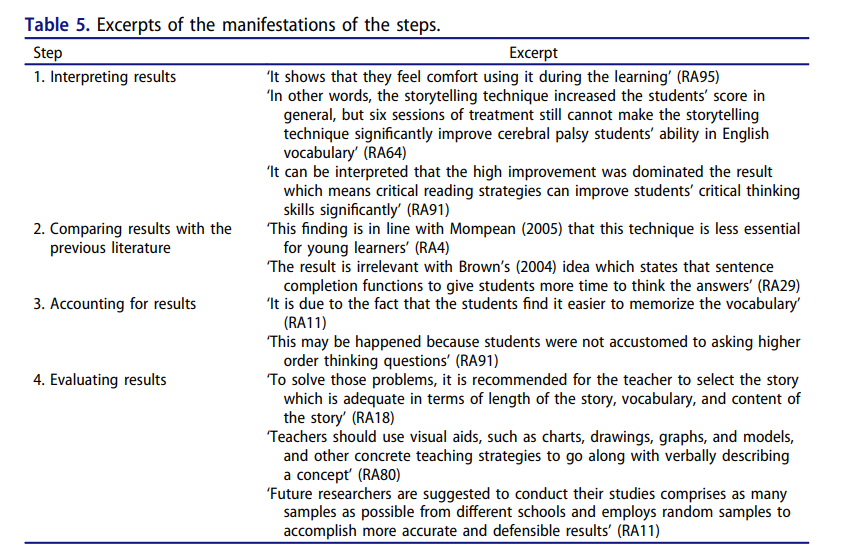
To provide a clearer understanding of how Move 4 is manifested in actual research writing, Table 7 presents excerpts illustrating each of the four steps: interpreting results, comparing results with previous literature, accounting for results, and evaluating results.
5. Move 5: Summarize the Research. It briefly highlights key findings and their implications.
For example: “In summary, both internal and external factors significantly influence the effectiveness of English teaching at primary schools.”
6. Move 6. Evaluate the Research. It points out limitations, emphasizes the study’s contributions, or evaluates the methods used.
For example: “While the study provides insights into primary English education, the limited sample size may affect generalizability.”
6. Move 7. Deductions from the Research. It covers suggestions, recommends future studies, and draws pedagogical implications.
For example: “Future studies should examine teacher training programs more comprehensively. Pedagogically, increasing professional development opportunities is crucial for effective English teaching.”
Read the two assigned articles carefully, focusing on the Findings and Discussion sections. Pay attention to how the authors present their results, interpret the findings, and structure the discussion. Note the key components and steps used in organizing the discussion, as these examples will help you better understand the practical application of structural moves in research writing.
The article titled Teachers’ Problems and Solutions in Implementing Curriculum 2013, authored by Yanuarti Apsari, was published in Acuity: Journal of English Language Pedagogy, Literature and Culture, Volume 3, Issue 1 (2018), pages 11–23. It can be accessed online at https://eric.ed.gov/?id=EJ1304494
| Move | The example |
| Move 1
Background Information |
 |
| Move 2
Report Result |
 |
| Move 3 Summarise Result | 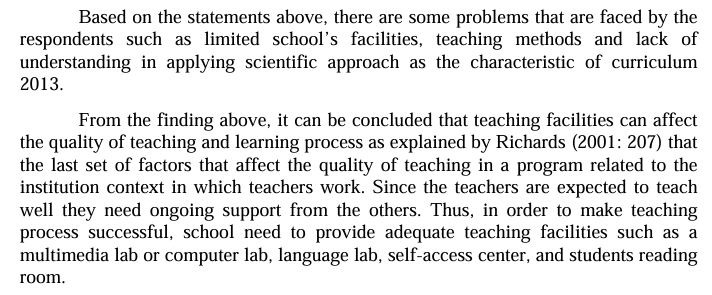 |
| Move 4 Comment on Results | |
| Move 5 Summarise the results | 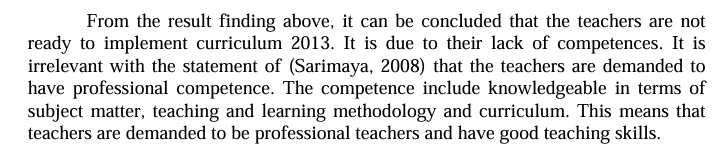 |
A. Worksheet 6.2 – Drafting Findings and Discussion Section
Instructions:
- Complete the table by drafting findings and discussion paragraphs based on yang and Allison (2003).
- Ensure each paragraph aligns with the intended rhetorical Move.
- Present quantitative data with tables, charts, or graphs.
- Present qualitative data as themes, categories, or illustrative quotes.
- Interpret results, link to previous studies or theories, and highlight implications or limitations.
- Use appropriate transition phrases to ensure cohesion.Manage in-text citations and references using Mendeley, and write full references in APA 7th edition style.
- If generative AI is used at any stage (e.g., idea refinement or language support), write a brief AI use statement specifying how the tool was used and affirming that the content, analysis, and interpretation remain your own.
| Move | Your Draft Text (Findings and Discussion) |
| Move 1 | |
| Move 2 | |
| Move 3 | |
| Move 4 | |
| Move 5 | |
| References
(APA Style) |
List all cited sources in APA 7th edition format generated and checked using Mendeley. |
| AI Use Statement | If generative AI is used (e.g., for language refinement or idea clarification), write a brief AI use statement describing how the tool was used and confirming that the analysis and content are the student’s own. |
Authentication required to view this assignment.
SHARING AND DISCUSSION (TRANSFORM)
At this stage, students share their draft Findings and Discussion sections with peers to receive feedback and refine their work. The focus is on improving clarity, cohesion, data presentation, and alignment with research objectives.
A. Worksheet 6.3 – Peer Review
Instructions
- Exchange or upload your draft written Findings and Discussion section with a peer.
- Focus your evaluation on three main aspects:
- Structural Moves / Rhetorical Completeness – Are the moves in Findings and Discussion clearly applied and complete?
- Academic Ethics – Is the writing original, properly paraphrased, and correctly cited?
- Digital Ethics – Are digital tools, software, and online data used responsibly, ethically, and securely?
3. Record your feedback using the rubric below. Provide specific suggestions for improvement.
Peer Review Rubric:
| Section | Indicators | 4- excellent | 3- good | 2- Fair | 1-Poor |
| Structural Moves / Rhetorical Complete
ness |
Rhetorical organization based on Yang & Allison (2003) | All 7 moves are applied | Most moves applied; minor missing steps | Several moves or steps missing; unclear connections | Moves mostly absent or unclear; results/discussion poorly structured |
| Academic Ethics | Originality and ethical paraphrasing | Fully original; no patchwriting | Mostly original; minor patchwriting | Frequent weak paraphrasing | Copying or clear plagiarism |
| Citation accuracy | All claims are properly cited | Minor citation errors | Several uncited claims | No or incorrect citation | |
| Digital Ethics | Ethical use of digital tools (e.g.,AI) | Transparent, responsible use | Minor overuse or lack of clarity | Overliance on tools | Unethical use of digital tools |
Authentication required to view this assignment.
DRAFTING AND REFINING (HONE)
At this stage, students revise and refine their draft Findings and Discussion sections based on peer feedback and lecturer comments. The focus is on producing a clear, cohesive, and well-structured final draft that aligns with research objectives and demonstrates effective use of data presentation and Swales’ structural moves.
A. Worksheet 6.4 – Refining Research Findings and Discussion Drafts
Instructions
- Review all comments from peers and lecturers on your draft Findings and Discussion section.
- Revise your draft based on feedback given by peers and lecturer
- Ensure all references and citations follow APA 7th edition style.
- Upload your revised draft to the class platform.
Authentication required to view this assignment.