
TOPIC 5. WRITING METHOD
INTRODUCTION
A. Learning Objectives
After completing this session, students are expected to be able to:
- Explain the rhetorical structure and communicative purposes of the Method section based on Pho’s (2008) move framework.
- Apply Pho’s rhetorical moves to design and clearly describe research instruments ethically and transparently, ensuring methodological validity, accurate reporting, and compliance with academic ethics (e.g., informed data collection and proper citation).
- Evaluate and refine Method section drafts and research instruments through peer review, focusing on rhetorical completeness (according to Pho’s moves), methodological rigor, clarity of explanation, and responsible use of digital tools in accordance with digital ethics.
B. Skill Focus of This Session
This session emphasizes the rhetorical construction of the Method section in scientific articles, particularly through the application of Pho’s (2008) move framework. Students progress from understanding methodological functions and rhetorical purposes to ethical drafting, peer evaluation, and reflective refinement of Method section drafts.
C. Micro Skills Developed
In this session, students will develop the ability to:
- distinguish the rhetorical moves in the Method section according to Pho’s framework and explain their communicative functions,
- identify linguistic and structural features used to describe research design, participants, instruments, data collection, and data analysis,
- describe research instruments and procedures clearly, systematically, and transparently,
- apply academic and digital ethics in methodological writing, including responsible reporting, accurate citation, and transparency of research practices,
- use digital tools (e.g., reference managers or AI-assisted tools) responsibly to support clarity, consistency, and accuracy in Method section drafting,
- apply structured peer review criteria to evaluate rhetorical completeness, methodological rigor, and ethical compliance in Method section drafts.
These micro skills strengthen students’ technical control over methodological description, rhetorical organization, and ethical research reporting.
D. Macro Skills Developed
Building upon these abilities, students will develop the capacity to:
- construct a coherent, rigorous, and ethically sound Method section aligned with disciplinary conventions,
- demonstrate critical awareness of methodological validity, transparency, and replicability in academic research writing,
- evaluate and refine methodological writing through reflective peer review and self-assessment,
- make informed and responsible decisions regarding the use of digital technologies in research writing,
- engage in scholarly communication practices that enhance the credibility and trustworthiness of their research.
Through these macro skills, students move beyond procedural description toward strategic and ethical methodological writing, positioning themselves as responsible and competent emerging researchers.
BRAINSTORMING (YIELD)
At this stage, students work individually to explore provided research instruments, including a sample questionnaire and a structured interview guide. The purpose of this activity is to help students understand how these instruments are designed to align with specific research objectives and how they are typically reported in the Method section of academic articles. Students first examine the provided instruments carefully, paying attention to:
- The structure and organization of items or questions.
- The wording used to ensure clarity and avoid bias.
- How each item or question is linked to research objectives.
After studying the examples, students then develop their own instruments:
- Interview questions (at least 5–7) that are open-ended, clear, and directly connected to their research objectives.
- Questionnaire items (8–10) that can be closed-ended (e.g., Likert scale) or open-ended, aligned with the focus of their study, and easy to understand for respondents.
A. Worksheet 5.1 Developing Research Instruments
Instructions:
- Study the provided instruments below.
The following example represents a set of research instruments adapted for a study entitled “Research Instruments: Students’ Voices on Digital Tools in Writing.” These instruments were designed to collect data from students using three approaches: a Likert-scale questionnaire, semi-structured interviews, and classroom observations. The questionnaire aims to explore students’ voices regarding the use of digital tools in writing, while the interview guide provides deeper insights into their experiences and challenges. The observation sheet is included to triangulate the findings by documenting how digital tools are applied in real classroom settings.
- Questionnaire (Likert Scale)
Theme: Students’ Perceptions of Digital Tools in Writing
Scale: 1 = Strongly Disagree, 2 = Disagree, 3 = Agree, 4 = Strongly Agree
- Digital tools (e.g., Google Docs, Grammarly) help me organize my writing better.
- Using digital tools makes it easier to revise my writing.
- I feel more motivated to write when I use digital tools.
- Digital tools improve the accuracy of my grammar and vocabulary.
- I can collaborate more effectively with peers through digital platforms.
- Feedback received through digital tools is useful for improving my writing.
- I can access more resources and references through online tools.
- Digital tools save time in the writing process.
- I feel more confident in my writing when I use digital tools.
- Digital platforms encourage me to write more frequently.
- I find it easy to learn new digital writing tools.
- Digital tools make writing tasks more enjoyable.
- I believe digital tools are essential in academic writing today.
- Using digital tools enhances my creativity in writing.
- I prefer using digital tools over traditional pen-and-paper methods.
- Digital tools allow me to track my progress in writing.
- I feel more independent in learning when I use digital tools.
- Digital tools make peer-review activities more effective.
- I experience fewer difficulties in writing assignments with digital tools.
- I would like teachers to integrate more digital tools in writing courses.
- Interview Guide (Semi-Structured)
Theme: Students’ Voices on Digital Tools in Writing
- What digital tools do you usually use in writing tasks?
- How do these tools help you in developing your academic writing?
- Can you describe any challenges you face when using digital tools for writing?
- How do digital tools affect your motivation and confidence in writing?
- Do you think digital tools make collaboration with peers easier? Why or why not?
- In what ways do digital tools influence the quality of your writing?
- What kind of support do you expect from lecturers regarding the use of digital tools?
- How would you like to see digital tools integrated in future writing courses?
- Observation Sheet
Theme: Classroom Observation on the Use of Digital Tools in Writing
| Aspect Observed | Indicators | Yes/No | Notes |
| Students use digital tools actively | Tools such as Google Docs/Grammarly/AI checked | ||
| Collaboration occurs via digital platforms | Sharing documents, co-editing, giving comments | ||
| Teacher facilitates digital tool use | Demonstration, monitoring, feedback | ||
| Students show engagement | Focus, participation, enthusiasm | ||
| Challenges appear | Technical problems, lack of skills |
Based on the sample instruments provided, develop your own data collection tools/ instruments:
- Interview Questions – Create 5–7 open-ended questions that are clear, easy to understand, and directly linked to your research objectives.
- Questionnaire Items – Design 8–10 items (Likert-scale) that are simple and relevant to your study focus.
- Observation Checklist – Prepare 4–6 aspects to observe in classroom or learning settings. Each aspect should include indicators that reflect your research objectives.
Authentication required to view this assignment.
INDIVIDUAL EXPLORATION (YIELD)
At this stage, students work individually to develop and write their own Method section for their research project. Using the sample Method section from a reputable journal and the provided research instruments (questionnaire and interview guide) as references, students are asked to:
- Identify the key elements to include in their Method section, such as research design, participants, instruments, and procedures.
- Ensure that the description of instruments (questionnaire and interview guide) aligns with their research objectives.
- Write their Method section in a clear and replicable manner, paying attention to academic style, tense, and voice commonly used in Method sections.
- Integrate any additional methodological details relevant to their study, such as ethical considerations or data analysis procedures.
Before writing your own Introduction section, it is important to first read examples from reputable journals to see how experienced authors begin their research articles. By examining these samples, you will learn how background information is introduced, how research gaps are highlighted, and how research aims are presented in a clear and logical flow. This activity will help you understand the structure and style expected in academic writing, providing a model to guide you when developing your own Introduction. To begin, please read the two sample Introduction sections provided below.
-
Input and Output-Based Activities to Engage Primary School Students in Learning English”,
This article was written by Irfan Fajrul Falah, Yanuarti Apsari, Rita Kusumah, Asep Usamah, and Agatha Kristi Pramudika Sari. It was published in the Journal of Lifestyle and SDGs Review, Volume 4, Issue 1, in March 2024. This journal is indexed in SCIMAGO Q4. You can access the full article via the following link: https://www.sdgsreview.org/LifestyleJournal/article/view/5562.
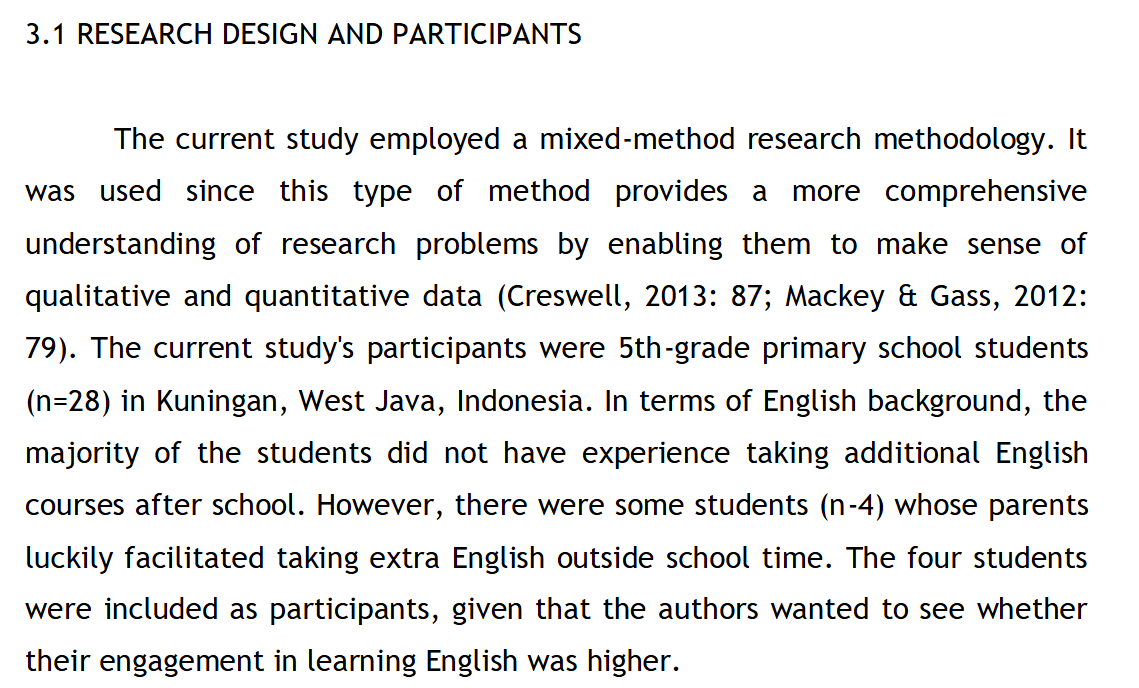
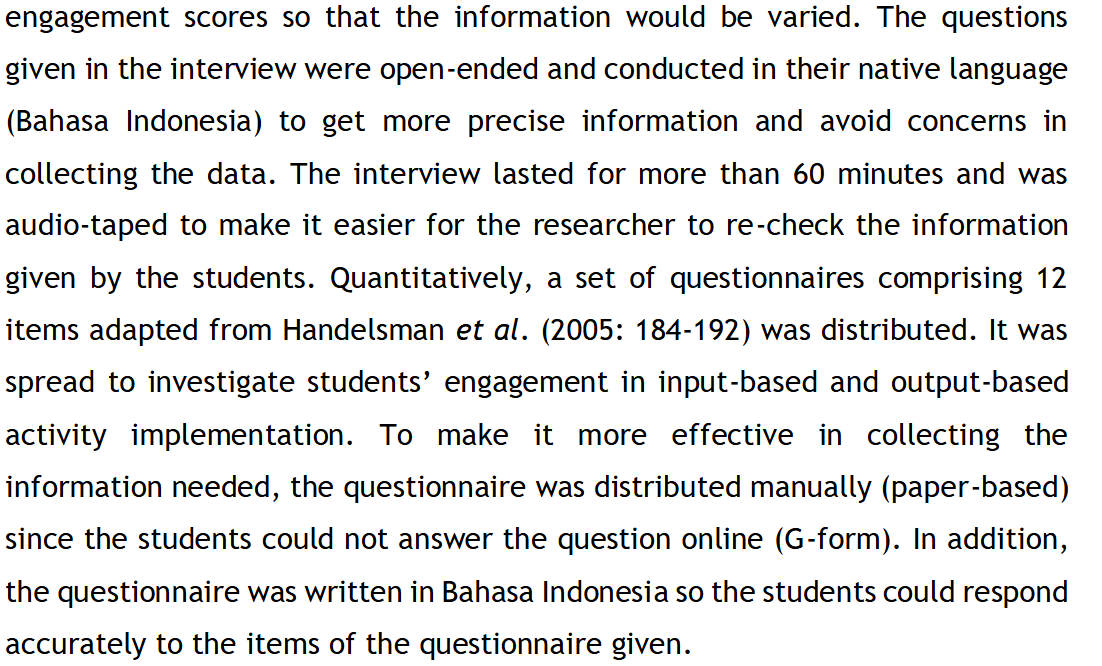
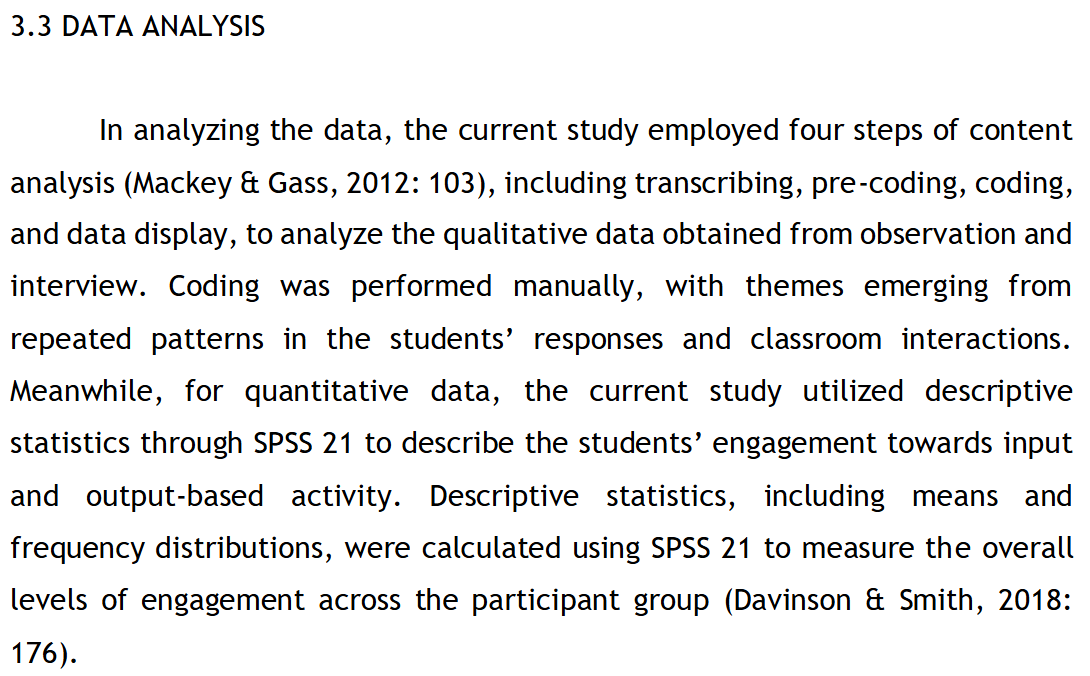
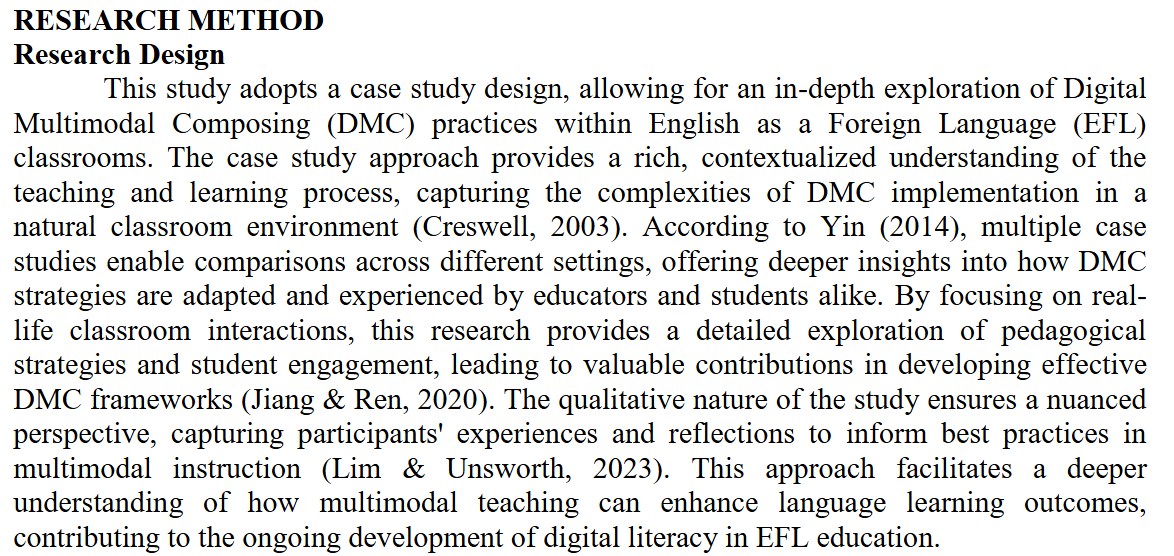
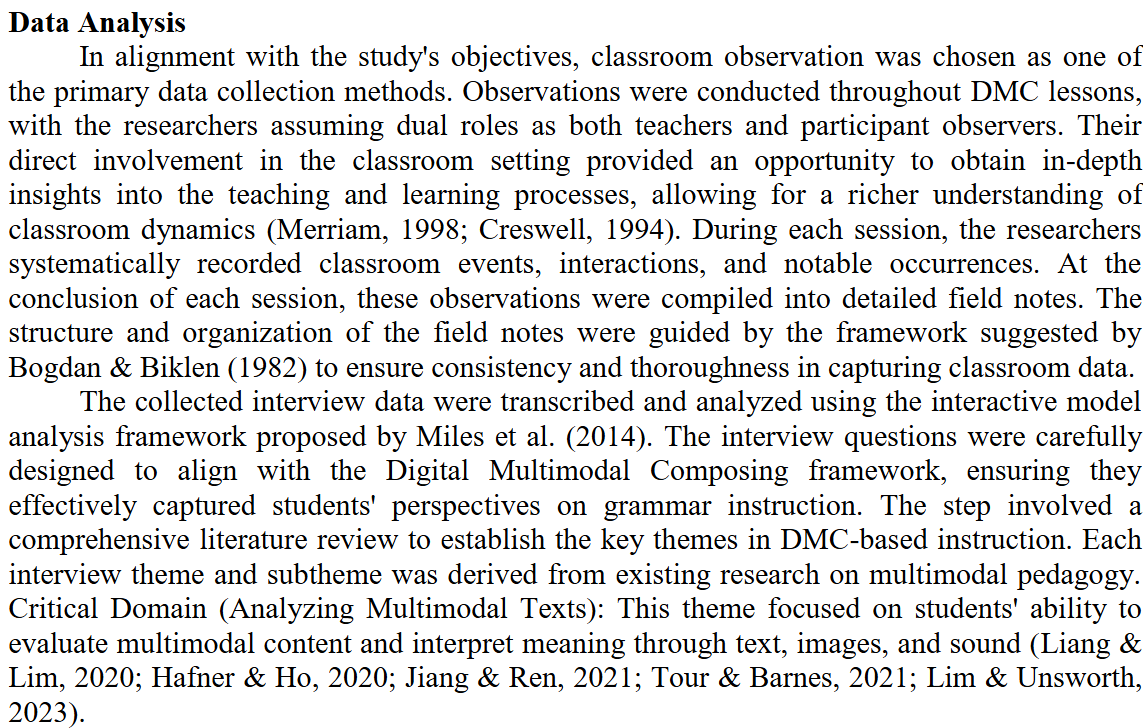
For this activity, please read the Method section of the article. This section outlines the research design, participants, data collection methods, and data analysis procedures used in the study. Understanding these components will help you in structuring your own research methodology.
-
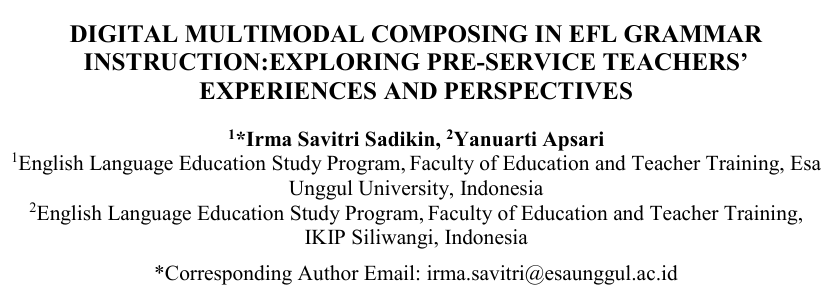
Digital Multimodal Composing in EFL Grammar Instruction: Exploring Pre-Service Teachers’ Experiences and Perspectives
The second article is written by Irma Savitri Sadikin (Esa Unggul University) and Yanuarti Apsari (IKIP Siliwangi). It was published in JOLLT (Journal of Languages and Language Teaching), Vol. 13, No. 3 (2025). The full article can be accessed https://e-journal3.undikma.ac.id/index.php/jollt/article/view/14709
Please read the Method section carefully as a guide for understanding the research procedures.
A. Worksheet 5.2 – Writing a Clear and Organized Method Section (Pho, 2008)
Instructions
- Write each part of your Method section in the Student Work column.
- Follow Pho’s (2008) framework to ensure your Method section is clear, systematic, and aligned with research objectives and questions.
- Manage in-text citations and references using Mendeley, and write full references in APA 7th edition style.
- If generative AI is used at any stage (e.g., idea refinement or language support), write a brief AI use statement specifying how the tool was used and affirming that the content, analysis, and interpretation remain your own.
| Pho’s (2008) Move | Students Draft |
| Research Design | |
| DC1: Describing Research Context | |
| DC2: Describing Sample / Respondents | |
| DC3: Describing Instrument | |
| DC4: Elaborating Data Collection Procedure | |
| DC5: Justifying Data Collection Procedure | |
| DC6: Verifying Compliance with Ethical Standard | |
| DA1: Recounting Data Analysis Procedure | |
| References
(APA Style) |
List all cited sources in APA 7th edition format generated and checked using Mendeley. |
| AI Use Statement | If generative AI is used (e.g., for language refinement or idea clarification), write a brief AI use statement describing how the tool was used and confirming that the analysis and content are the student’s own. |
The outcome of this activity is an initial draft of the Method section that will later be refined in the Sharing and Discussion stage (T 5.3) through peer and lecturer feedback.
Authentication required to view this assignment.
SHARING AND DISCUSSION (TRANSFORM)
At this stage, students exchange their draft Method sections with peers for review and feedback.
A. Worksheet 5.3 – Peer Review for Method Section
Instructions
- Exchange your draft Method section with a peer.
- Evaluate the draft using the rubric below.
- Focus on:
- Structural Moves / Rhetorical Completeness – Is every component of the Method section explained clearly, completely, and logically (Pho, 2008)?
- Academic Ethics – Does the draft follow academic standards: proper citation, originality, honesty, and transparency?
- Digital Ethics – Are digital tools, software, and online data used responsibly and ethically, and is participant data protected?
Peer Review Rubric:
| Section | Indicators | 4- excellent | 3- good | 2- Fair | 1-Poor |
| Structural Moves / Rhetorical Completeness | Rhetorical organization based on Pho | All moves are complete | Move are mostly complete | Moves are incomplete | Moves are absent |
| Academic Ethics | Originality and ethical paraphrasing | Fully original, ethical paraphrasing | Mostly original; minor patchwriting | Frequent weak paraphrasing | Copying or clear plagiarism |
| Citation accuracy | All claims are properly cited | Minor citation errors | Several uncited claims | No or incorrect citation | |
| Digital Ethics | Ethical use of digital tools (e.g.,AI) | Tools are used transparently and respondibly as support | Minor overuse or lack of clarity | Overliance on tools | Unethical use of digital tools |
The outcome of this stage is a set of peer-reviewed suggestions that students can use to revise and refine their Method section in the next stage (T 5.4 Drafting and Refining).
Authentication required to view this assignment.
B. Follow-Up Activity: Wordwall Quiz on Writing Methodology
Platform: Wordwall – How to Write Methodology in a Research Paper – Correct the Sentences
Activity Type: Sentence correction (error-identification & editing)
Description:
Students will complete an interactive Wordwall activity focused on improving the clarity and accuracy of sentences commonly found in the methodology section of research papers. In this activity, participants are presented with several sample sentences that describe methodological elements (such as research approach, participants, instruments, data collection, and analysis). They then correct grammatical or structural errors to polish the text.
Implementation Instructions:
- Share the Wordwall link with students: https://wordwall.net/id/resource/96630082
- Students log in and work on the activity individually.
- The quiz provides instant feedback for each correction.
- Lecturer reviews results collectively to address common errors in sentence structure or methodological phrasing.
DRAFTING AND REFINING (HONE)
At this stage, students revise and refine their Method section draft based on feedback received from peers and the lecturer during the previous Sharing and Discussion (T 5.3). This stage emphasizes improving clarity, coherence, alignment with research objectives, and adherence to academic writing standards.
A. Worksheet 5.4- Revising and Refining the Method Section
Instructions:
At this stage, you will revise your Method section draft based on feedback received from peers and the lecturer during the previous Sharing and Discussion (Worksheet 5.3). Focus on improving clarity, coherence, alignment with your research objectives, and adherence to academic writing standards.
- Review Feedback.
Examine all feedback carefully, paying attention to:
- Clarity of each section (Research Design, Participants, Instruments, Procedure, Data Analysis)
- Logical flow and coherence of information
- Alignment with research objectives and research questions
- Accuracy of references and APA 7th formatting
- Language, grammar, and academic writing style
- Revise Method Section
Update your draft by integrating suggestions and ensuring that each section follows Swales’ structural moves. - Finalize Research Instruments
Ensure that your questionnaire and interview guide are consistent with your Method section and research objectives. - Prepare for Submission
Authentication required to view this assignment.
B. Follow-Up Activity: Wordwall Quiz on Writing Methodology
Platform: Wordwall – How to Write Methodology in a Research Paper – Correct the Sentences
Activity Type: Sentence correction (error-identification & editing)
Description:
Students will complete an interactive Wordwall activity focused on improving the clarity and accuracy of sentences commonly found in the methodology section of research papers.
Implementation Instructions:
- Share the Wordwall link with students: https://wordwall.net/id/resource/96630082
- Students log in and work on the activity individually.
- The quiz provides instant feedback for each correction.