
TOPIC 2. INVESTIGATING PRACTICES AND CONVENTIONS IN SCIENTIFIC ARTICLE WRITING
INTRODUCTION
A. Learning Objectives
After completing this course session, students are expected to be able to:
- Identify the process of writing scientific articles in English Language Education
- Explain the characteristics of a high-quality scientific article according to academic standards.
- Identify the writing requirements based on journal guidelines from reputable journals.
- Explore the challenges faced by article writers and the solutions they implement.
B. Skill Focus of This Session
This session is designed to develop students’ academic writing competence through a gradual progression from understanding established conventions to critically engaging with real academic practices.
C. Micro Skills Developed
In this session, students will develop the ability to:
- recognize the stages involved in writing scientific articles in English Language Education,
- identify key quality indicators of publishable academic articles,
- interpret journal author guidelines related to structure, formatting, referencing, and ethics,
- extract relevant insights from writers’ experiences regarding challenges and practical solutions.
These micro skills support students’ comprehension of academic norms and conventions that govern scientific writing.
D. Macro Skills Developed
Building on these foundational abilities, students will develop the capacity to:
- critically evaluate scientific articles against recognized academic standards,
- connect journal requirements with real-world writing and publishing practices,
- synthesize insights from guidelines and practitioner experiences to inform their own academic writing decisions.
These macro skills prepare students to approach scientific writing as a strategic, reflective, and standards-driven academic practice.
BRAINSTORMING
In the previous meeting, you conducted interviews with journal editors, reviewers, or experienced authors to explore their perspectives on scientific article writing. Now, in this session, students are asked to share your group’s findings with the class. To make your presentation clear and effective, follow these steps with your group:
Step 1: Share
Present the key insights from your interview (e.g., process, challenges, article quality, or resources).
Step 2: Explain
Tell the class why these insights are important for understanding the practices and conventions of scientific article writing.
Step 3: Connect
Relate your findings to your own needs as a student writer, and suggest questions or ideas to explore in the next activity.
At this stage, you will reflect on and explore the insights gained after listening to other groups’ presentations of their interview findings. The goal is to deepen your understanding of scientific writing practices and identify patterns across different groups’ experiences.
A. Worksheet 2.1 – Insight from interview data
- This topic has 72 replies, 29 voices, and was last updated 5 months ago by
.


- You must be logged in to reply to this topic.
INDIVIDUAL EXPLORATION
At this stage, students are encouraged to explore new materials that can deepen their understanding of scientific writing practices. The focus is on connecting their previous interview findings with authentic resources from reputable journals. Two key resources are provided: Journal Guidelines and Sample Articles. Both of these resources serve as practical tools to help students see the expectations of academic publishing and how those expectations are realized in real publications.
The transition from interview results to written guidelines and published articles is important. Interviews provide insights into the experiences of editors, reviewers, and published authors, while guidelines and articles show how those insights are applied in practice. By combining both, students will be able to understand the process of writing and publishing not only from theory and opinion but also from actual evidence.
A. Journal Guidelines
Journal guidelines are official instructions issued by publishers to ensure that all submitted articles meet professional and academic standards. These guidelines usually include details about article length, required structure (such as title, abstract, introduction, methods, results, discussion, and conclusion), citation and referencing style, formatting rules, and ethical considerations like plagiarism and originality.
For students, studying journal guidelines provides a clear picture of what editors and reviewers expect from a manuscript. It also emphasizes that successful publication is not only about having strong research ideas but also about presenting them in a way that matches the journal’s standards.
In this subsection, students will:
- Review Author Guidelines from reputable journals in English Language Education.
- Identify similarities and differences in structure, formatting, and referencing style.
- Discuss why following journal guidelines is essential for publication success.
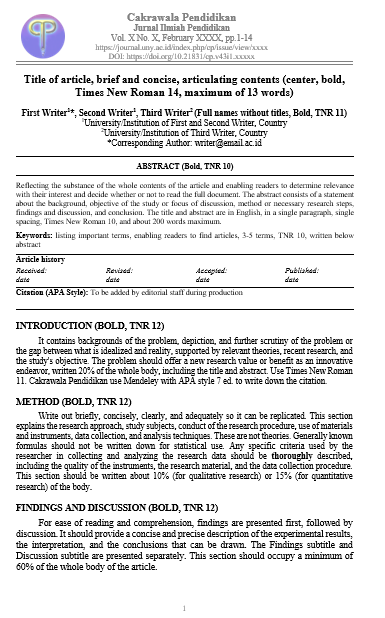
To illustrate this more concretely, below is an excerpt from the Author Guidelines of two respected journals
- Indonesian Journal of Applied Linguistics (IJAL), a Q2-ranked journal in the field of linguistics and language education (IJAL Author Guidelines):
- Meanwhile, Cakrawala Pendidikan, an international education journal indexed in Scopus Q3, presents its Author Guidelines in two parts: a Journal Template and a Prior Submission Checklist, both of which guide authors in preparing manuscripts that meet the journal’s requirements (Cakrawala Pendidikan Author Guidelines).
- Author guidelines of IJAL Journal:
- Prior to submission, register and login as an author to the system.
- Manuscript must be submitted through the system of the journal. Manuscript submissions through email will not be considered.
- The manuscript should contain between 5,000 to 7,000 words with single space (excluding Abstract and Reference section) and in one column style.
- The submitted manuscript is in English with doc., docx., or rtf. formats, single space, 12 font size, Times New Roman, A4 paper with 2.54 cm margins.
- No header or footer is required. If needed, the author may use an endnote instead of footnote.
- The main headings include ABSTRACT, INTRODUCTION, METHOD, FINDINGS, DISCUSSION, CONCLUSION, and REFERENCES. Authors are allowed to use subheadings under the main headings. If necessary, ACKNOWLEDGEMENT and APPENDIX may be included.
- The title should be no more than 15 words, in sentence case, centered, 14 font size.
- The abstract must be between 200-250 words, consisting of the background of the study, the purpose of the paper, research methodology, and main findings/results, and conclusion. Following the abstract, write three to five keywords.
- The introduction should consist of the background of the study, research contexts, literature review, and research objectives.
- Introduction should be presented in the forms of paragraphs with the proportion of 15-20% of the whole article length.
- The method section consists of description concerning the research design, research site and participants or documents, data collection, and data analysis with the proportion of 10-15% of the total article length.
- The method section can be in a unified form or using subheadings.
- The findings and discussion section consist of description of the results of the data analysis to answer the research question(s) and their meanings seen from current theories and references of the area addressed. The proportion of this section is 40-60% of the total article length.
- The conclusion section consists of the summary and restatement of the main findings.
- Quotation, citations, tables, figures, and references must comply with the APA 7th edition citation style.
- Every source cited in the body of the article should appear in the reference, and all sources appearing in the reference should be cited in the body of the article.
- The sources cited should at least 80% come from those published in the last 5 years. The sources cited are primary sources in the forms of reputable journal articles (strongly recommended), books, and research reports, including theses and dissertations. Citations from journal should be at least 80% of the total references cited.
- Citation is done using bracket (last name and year of publication). When the sources are cited verbatim, page number is included (p. 78 or pp. 78-89).
- All forms of communication between the authors and the journal is via managingeditor.ijal@upi.edu or +62 81 321 028 274 (WhatsApp). Communication to other emails will not be considered.
- IJAL Journal Template
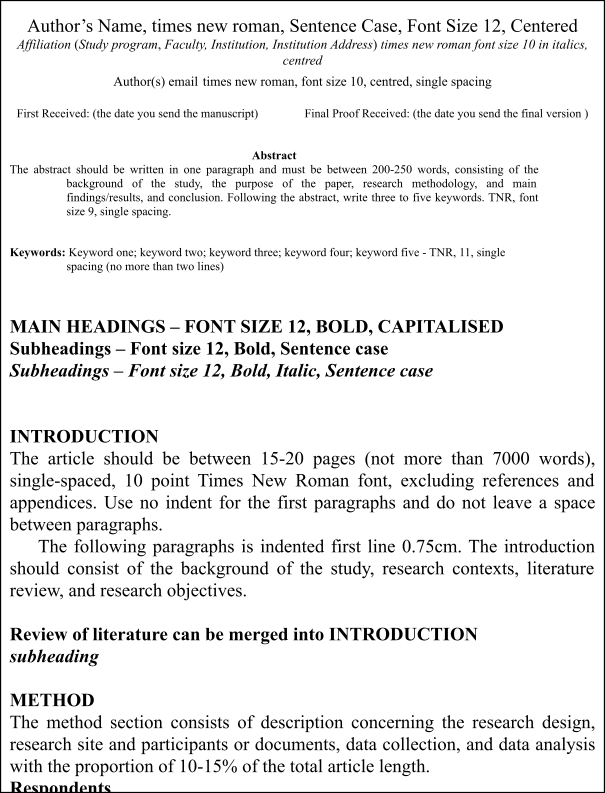
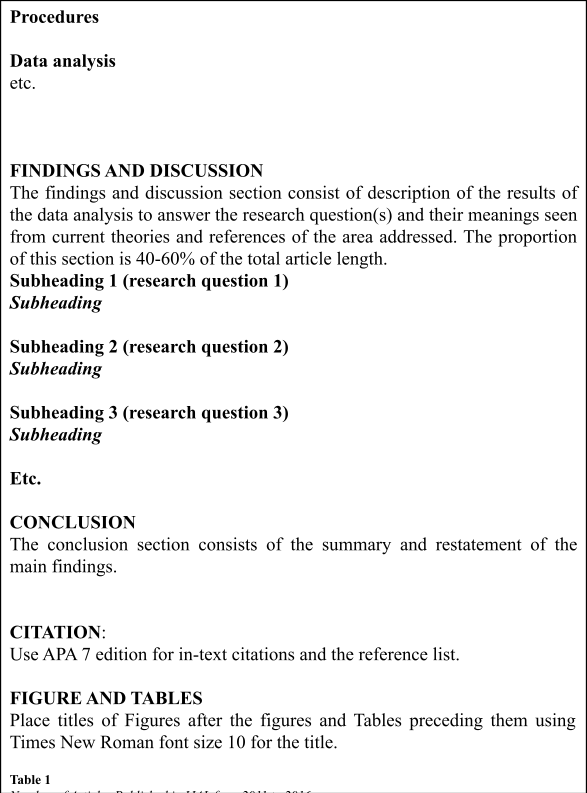
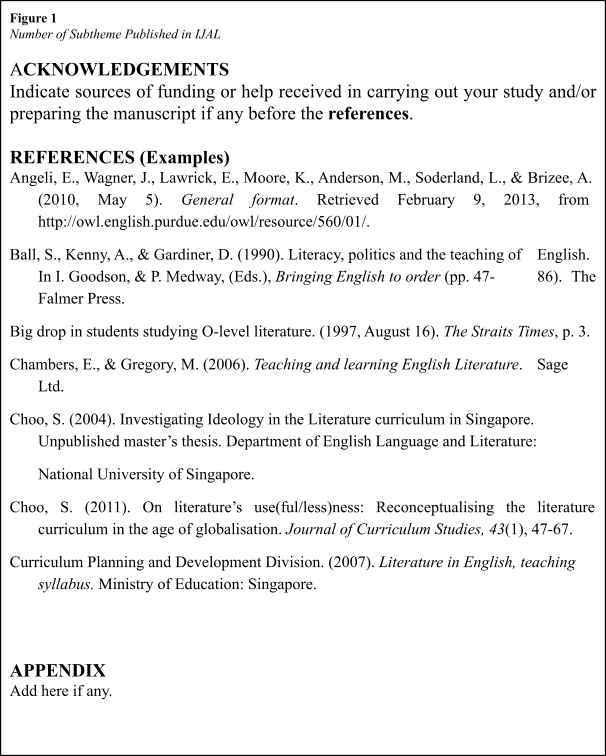
- Cakrawala Journal Template
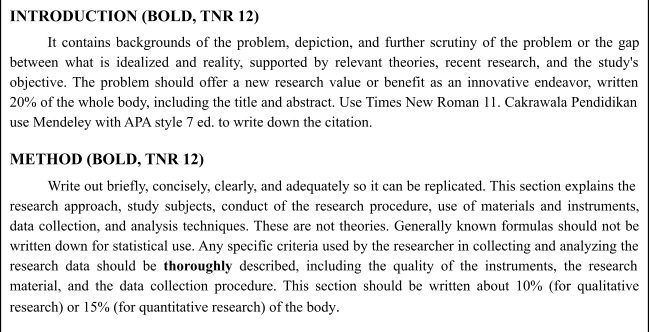
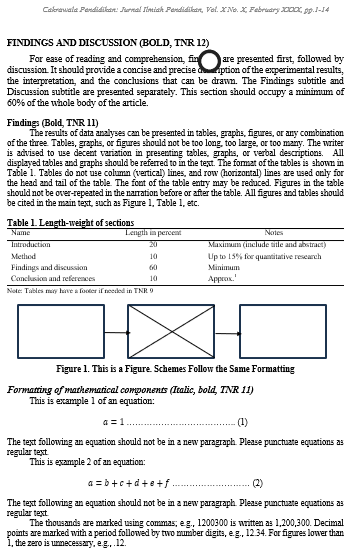
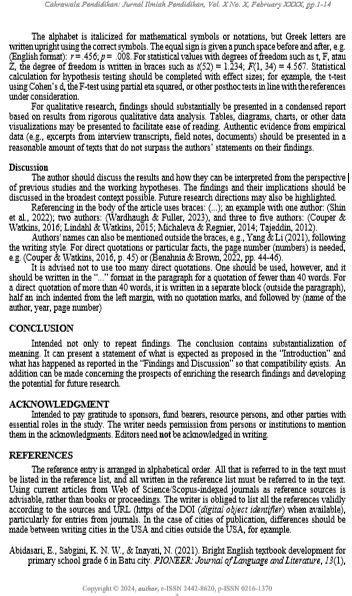
While journal guidelines provide a theoretical framework of what editors expect, published articles show how those guidelines are applied in real writing. To gain a more practical understanding, students need to analyze sample articles from reputable journals.
B. Sample Journal Articles
Sample articles from peer-reviewed, high-quality journals offer students concrete examples of publishable work. By studying them, students can observe how authors organize their articles, develop arguments, use evidence, and follow the journal’s specific requirements. These articles also serve as models of clarity, coherence, and academic style that students can learn from and adapt to their own writing.
Reading sample articles also helps students make connections between the written guidelines and actual practice. For instance, if a guideline specifies that the abstract must summarize objectives, methods, results, and implications, students can look at how each published article structures its abstract accordingly.
In this subsection, students will:
- Read selected articles from reputable journals in English Language Education.
- Observe how each section of the article (abstract, introduction, methods, results, discussion) is written.
- Compare published articles with journal guidelines to identify consistency and differences.
To illustrate this more clearly, the following is an excerpt from a published article in a reputable journal. The article “BIPA teachers’ perspectives on Digital Game-Based Language Learning (DGBLL): Attitudes, benefits and challenges in teaching Indonesian as a foreign language.” by Laily Rahmatika, Yanti Sariasih, M Monjurul Islam, Tri Agustini Solihati, and Sigit Haryanto, published in the Indonesian Journal of Applied Linguistics (IJAL), can be accessed in full at this link :
https://ejournal.upi.edu/index.php/IJAL/article/view/75959/32634
By analyzing both journal guidelines and sample articles, students gain a comprehensive understanding of scientific writing expectations. Guidelines provide the rules, while sample articles provide real applications. Together, these resources equip students with the knowledge they need to prepare their own manuscripts that meet academic publishing standards.
C. Worksheet 2.2- Comparing Interview Insights with Journal Guidelines
- This topic has 54 replies, 27 voices, and was last updated 5 months ago by


- You must be logged in to reply to this topic.
This activity helps you connect real-world experiences from interviews with formal standards and best practices in scientific publishing, enhancing your critical thinking and understanding of high-quality scientific writing.
SHARING AND DISCUSSION
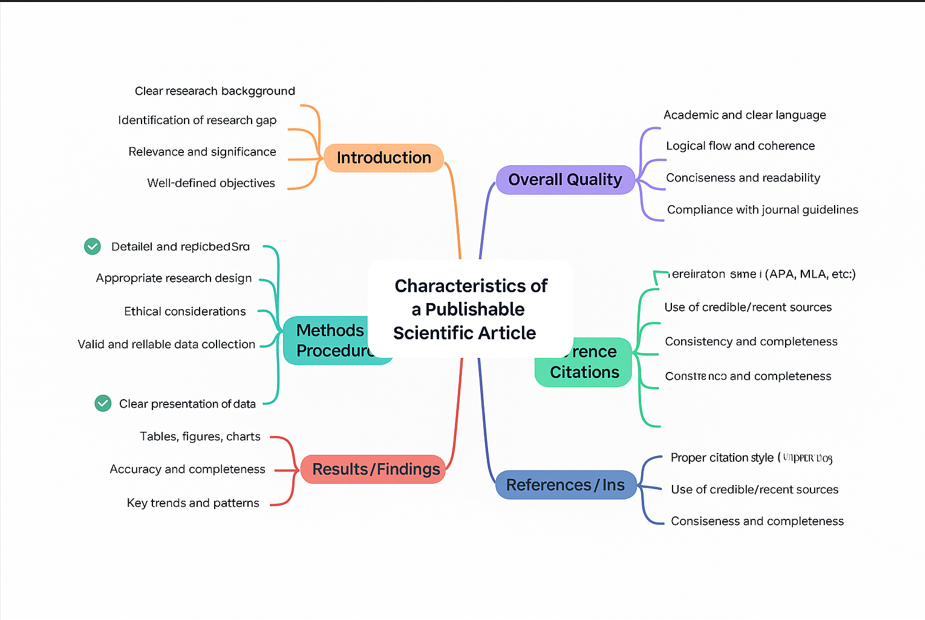
In this section you are required to organize and visualize the key characteristics of a high-quality scientific article that can be published in reputable journals, based on your interview insights and the provided materials (author guidelines and sample articles).
A. Worksheet 2.3 – Creating a Mind Map of a Publishable Scientific Article
- This topic has 68 replies, 33 voices, and was last updated 2 months, 3 weeks ago by
.



- You must be logged in to reply to this topic.
DRAFTING AND REFINING
After creating your group mind map on the characteristics of a publishable scientific article, students will now individually present their reflections using a voice recording on Vocaroo.com. This method allows concise oral presentation of insights while saving classroom time.

