
TOPIC 3. ANALYZING THE STRUCTURE OF SCIENTIFIC ARTICLES
INTRODUCTION
A. Learning Objectives:
After completing this session, students are expected to be able to:
- Explain the basic concepts and functions of rhetorical and structural moves in scientific articles.
- Recognize examples of rhetorical and structural moves in all sections of scientific articles (abstract, introduction, methodology, results, discussion, conclusion).
- Analyze and classify rhetorical and structural moves in published articles to extract general writing principles.
- Draft an initial research outline (title, background, research gap, objectives, and method) using AI as a supportive tool for idea refinement.
B. Skill Focus of This Session
This session strengthens students’ awareness of how scientific articles are rhetorically constructed and how those constructions guide readers’ understanding. The learning progression moves from conceptual understanding to analytical competence and finally to guided production.
C. Micro Skills Developed
In this session, students will develop the ability to:
- identify move patterns in different sections of scientific articles,
- recognize linguistic signals that indicate specific rhetorical purposes,
- organize key components of a research outline systematically,
- use AI tools critically to refine ideas while maintaining academic ownership.
These micro skills help students decode how published articles are constructed and how meaning is strategically developed.
D. Macro Skills Developed
Building upon these foundational abilities, students will develop the capacity to:
- critically analyze the rhetorical organization of published scientific articles,
- generalize writing principles from authentic journal texts,
- apply rhetorical awareness to design their own research framework,
- integrate technological tools (AI) responsibly as part of an academic writing process.
Through these macro skills, students begin transitioning from readers of research to emerging research writers who understand not only what to write, but also why and how each section fulfills its communicative function.
BRAINSTORMING
In this stage, students are encouraged to activate their prior knowledge about the structure of a scientific article. To support this process, an interactive activity using Wordwall is used at the beginning of the brainstorming stage to help students recall and recognize the main components of a research article. The brainstorming activity aims to help students:
- Recognize the common sections of a scientific article (Title Page, Abstract, Introduction, Methods, Results, Discussion, and Conclusion),
- Identify the basic purpose and function of each section, and
- Reflect on challenges they may face when writing each section.
A. Worksheet 3.1 Brainstorming Activity: Wordwall Quiz on Components of a Research Article
Activity Type: Match-Up (drag and drop)
Activity Title: Make a Match: Components of Research Article
Link: https://wordwall.net/resource/13342551
Description:
Students will complete an interactive Wordwall activity where they match each component of a research article (e.g., Title Page, Abstract, Introduction, Method, Results, Discussion, Conclusion, Acknowledgement) with its correct description or function. The activity provides instant feedback, allowing students to review mistakes and retry.
Instructions for Students:
- Click the link: Wordwall Activity.
- Once the page opens, press “Start” to begin the quiz.
- You will see a list of research article components and a list of their descriptions/functions.
- Drag and drop each component to the correct description.
- After completing all matches, click “Submit” to check your answers.
INDIVIDUAL EXPLORATION
Understanding Structural Moves in Scientific Articles
A. Worksheet 3.2 – Analyzing the Structure of Scientific Articles
1. Worksheet 3.2.1 – Analyzing the Introduction Section
- This topic has 66 replies, 31 voices, and was last updated 4 months, 3 weeks ago by
.


- You must be logged in to reply to this topic.
2. Worksheet 3.2.2 – Analyzing the Methods Section
- This topic has 56 replies, 26 voices, and was last updated 4 months, 3 weeks ago by
.


- You must be logged in to reply to this topic.
3. Worksheet 3.2.3 – Analyzing the Findings and Discussion Sections
- This topic has 8 replies, 4 voices, and was last updated 4 months, 3 weeks ago by
.

- You must be logged in to reply to this topic.
4. Worksheet 3.2.4 – Analyzing the Conclusion Section
- This topic has 2 replies, 1 voice, and was last updated 4 months, 3 weeks ago by
- You must be logged in to reply to this topic.
5. Worksheet 3.2.5 – Analyzing the Abstract Section
- This topic is empty.
- You must be logged in to reply to this topic.
SHARING AND DISCUSSION
In this stage, students move from analyzing published articles and rhetorical moves toward identifying a potential research topic for their own study. To support this process, students are introduced to Connected Papers as a digital tool for exploring research networks and understanding how studies are conceptually connected.
A. Worksheet 3.3 – Identifying Research Topic through Literature Mapping
This worksheet aims to help you identify a research topic in English Language Education by exploring your academic interests and validating them through literature mapping using Connected Papers. The focus of this activity is on topic identification and justification based on existing research.
Instructions
- Identify one research area based on your academic interest related to English Language Teaching (ELT) (e.g., teaching methods, digital tools, assessment, curriculum, teacher or student perspectives).
- Formulate 2–3 key phrases or keywords that represent your area of interest.
- Enter one key phrase or a representative article related to your topic into Connected Papers.
- Examine the research map carefully.
- Complete the worksheet individually.
- Share and discuss your findings with your group and the class.
| Item | Description |
| Area of interest in ELT | |
| Reason for choosing this area | |
| Keywords / key phrases |
Based on the research map generated:
- List three recurring research themes related to your interest.
- Theme 1:
- Theme 2:
- Theme 3:
- Identify the common research context(s) found in related studies
(e.g., EFL/ESL, school level, online learning, ESP). - Identify commonly used research methods or approaches.
Answer:
- Based on the research network, identify one area that seems underexplored or less frequently studied.
- Explain briefly why this area could be worth investigating.
Write one proposed research topic derived from your literature exploration.
Authentication required to view this assignment.
DRAFTING AND REFINING
In this stage, students are asked to create a draft research outline that will serve as the foundation for their future scientific article. The outline should start from a clear research title and expand into the main components of a research plan, including the background of the study, problem statement, objectives, methods, and expected outcomes. At this stage, the focus is on drafting ideas in a structured way rather than achieving perfection. Students will first draft individually, then refine their outline based on feedback from peers and the lecturer.
A. Procedures for Using AI (ChatGPT) to Develop a Research Outline
Artificial Intelligence (AI), particularly ChatGPT, plays a supportive role in academic research by assisting researchers in generating ideas, mapping research trends, identifying research gaps, and refining key research components. AI should not replace researchers’ critical thinking; rather, it functions as an intelligent research assistant. The effectiveness of AI use depends on clear, specific, and strategic prompting.
The following procedures outline step-by-step guidance for utilizing ChatGPT to develop a novel, relevant, and academically sound research outline, as demonstrated in the instructional slides.
Stage 1: Research Idea Refinement (Idea Maturation)
The objective of this stage is to identify a focused, novel, and relevant research topic that addresses a clear gap in the literature. The procedures used in this stage are as follows:
- Determine a Broad Research Interest
Begin by identifying a broad area of interest based on academic background or research motivation (e.g., academic writing, technology-enhanced language learning, AI in education). - Use AI to Map Research Trends and Emerging Topics
ChatGPT is used to explore recent research trends and “hot topics” within the selected area.
Prompt Example 1 – Topic Mapping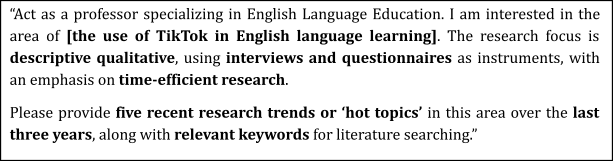
- Select a Potential Research Topic
Based on AI output and feasibility considerations, select one research topic.
Example topic:
Students’ Perceptions of TikTok as a Microlearning Tool for English Vocabulary: A Descriptive Qualitative Study
Stage 2: Identifying the Research Gap
The objective of this stage is to identify unexplored or under-researched areas that justify the proposed study. The procedures are as follows:
- Collect Recent Research Abstracts
Retrieve at least 5–10 recent abstracts from Google Scholar or other academic databases. - Use AI to Analyze Research Gaps
Prompt Example 2 – Research Gap Identification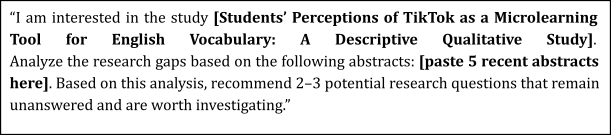
- Validate the Identified Gap
Reconfirm the gap by reviewing the original articles.
Example Output of Research Gap Identification Prompt (2)
| No. | Main Focus | Participants / Context | Methodology | Key Findings |
| 1 | Teachers’ and students’ attitudes toward TikTok as a microlearning tool in general EFL contexts | University students and lecturers (EFL department) | Mixed-methods | Positive attitudes toward TikTok; acceptance is influenced by perceived usefulness and ease of use. |
| 2 | The impact of TikTok on pronunciation learning | University students (EFL learners) | Mixed-methods | TikTok is effective and enjoyable for pronunciation practice; students tend to prefer native-speaker accents. |
| 3 | Students’ perceptions of learning English vocabulary through TikTok | 10 university students | Descriptive qualitative | TikTok supports vocabulary learning (daily expressions, idioms, slang), but may cause distraction. |
| 4 | Students’ perceptions and motivation in using TikTok for vocabulary learning | Senior high school students (Indonesia) | Qualitative | TikTok enhances vocabulary and learning motivation; however, it is insufficient as a primary learning resource. |
| 5 | Teachers’ perceptions of social media-based microlearning for speaking skills | Primary school teachers (China) | Case study | Microlearning via social media is promising but requires learner-centered design and community support. |
The example of Research Gap Statement from the previous prompt:
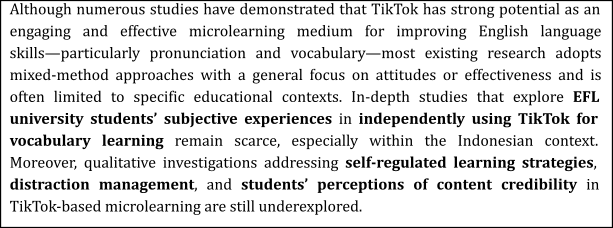
Stage 3: Formulating Research Questions
The objective of this stage is to formulate clear, focused, and researchable research questions aligned with the research gap. The procedures are as follows:
- Transform the Research Gap into Research Questions
- Use AI to Refine and Sharpen the Questions
Prompt Example 3 – Research Question Formulation - Select the Final Research Questions
The example of Recommended Research Questions from the previous prompt: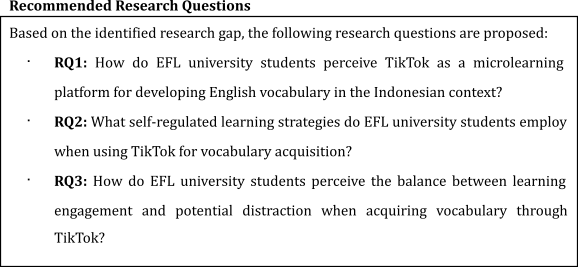
Stage 4: Determining Research Objectives
The objective of this stage is to develop research objectives that correspond directly to the research questions. It can be done by generating Research Objectives Using AI using the following prompt:
Prompt Example 4 – Research Objective Formulation

Stage 5: Determining the Research Title
According to Paiva et al., (2012), title is the most important element of a manuscript. Grant (2013) suggested that article titles should be concise, informative, and, where appropriate, give details of the research design. Thus, the purpose a title is to attract the readers in order to be interested in reading the paper. If a title is not informative, it cannot be indexed in the proper databases (Haggan, 2004). Furthermore, Swales and Feak (2004, p. 278) specified three requirements for decent research report titles: (1) the title should indicate the topic of the study; (2) the title should indicate the scope of the study; (3) the title should be self-explanatory to readers in the chosen area. This indicates that the title summarizes the main idea or ideas of your study.
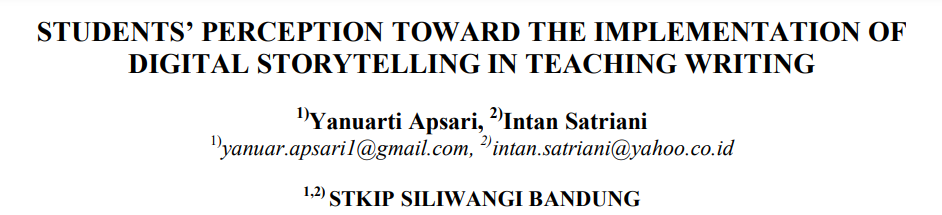
Before writing a scientific article, the first step to consider is preparing the title page. This page serves as the main identity of the paper and should be arranged neatly, clearly, and in accordance with the guidelines of the target journal or institution. The essential components commonly included in a title page are the article title, author’s name, institutional affiliation, and author’s contact information. The following image illustrates the key elements that should be presented on a title page.
The objective of this stage is to generate a clear, informative, and journal-oriented research title. The procedures are as follows:
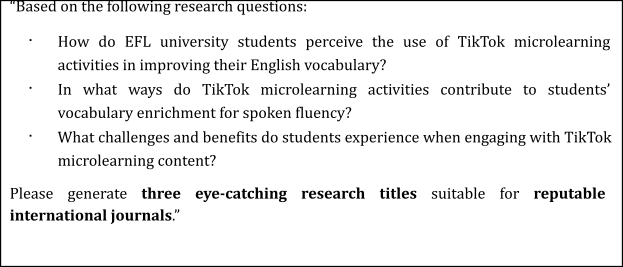
- Use Research Questions as the Basis for Title Development
- Generate Title Options Using AI
Prompt Example 6 – Research Title Generation
- Select and Refine the Final Research Title
Ethical Considerations in Using AI
- AI-generated content must not be copied verbatim into academic writing.
- AI is used to support ideation, refinement, and clarification, not authorship.
- All AI outputs must be verified with original scholarly sources.
- Researchers remain fully responsible for academic integrity.
When used strategically, ChatGPT can effectively support researchers in developing a systematic, coherent, and competitive research outline. By following these stages (idea refinement, gap identification, question formulation, objective alignment, and title development) researchers can benefit from AI assistance while maintaining academic rigor and ethical standards.
Styles of title
When creating the title of a scientific paper, it is important to pay attention to the writing style. A good title not only reflects the content of the study but also attracts readers’ interest. Common styles of titles include:
- Declarative title. These titles state the main findings or conclusions of the research directly. They provide readers with a clear idea of the study’s outcome at first glance. Example: “Contextual situation can promote prospective teachers’ creativity in posing mathematical problems.”
- Descriptive or Neutral Titles. These titles simply describe the subject matter of the article without revealing the results. They tend to be more neutral and objective, focusing only on the topic under discussion. Example: “Effects of contextual situation on prospective teachers’ creativity in posing mathematical problems.
- Interrogative (Question) Titles. These titles present the subject of the article in the form of a question, sparking curiosity and inviting readers to explore the answer in the paper. Example: “Can contextual situation promote prospective teachers’ creativity in posing mathematical problems?”
- Compound Titles. These titles usually combine two parts: a general phrase followed by a colon and a more specific statement. They may also start with a short question followed by a descriptive phrase. Example: “Contextual Situation and Creativity: Exploring Prospective Teachers’ Problem-Posing Skills.”
B. Worksheet 3.4 – Drafting Research Outline
This worksheet guides you to transform your finalized research topic (from Worksheet 3.3) into research titles and a structured research outline. You will refine your draft through peer and lecturer feedback, simulating the academic peer-review process commonly used in journal publication.
Instructions – Drafting Research Outline (Revised for Beginner Researchers)
- Research Topic
– Use the research topic finalized in Worksheet 3.3.
– Ensure that your topic is related to English Language Education (ELT), focusing on teaching, learning, curriculum, instructional models, media, or strategies. - Preliminary Reading
– Read 1–2 published journal articles with a similar or related theme to your research topic.
– These articles may serve as academic references and inspiration for your study.
– If studies with exactly the same theme are unavailable, refer to articles with closely related themes in ELT.
– Access sample articles here: Google Drive – Sample Articles - Drafting Titles
– Draft four different title styles based on your research topic.
– Titles should be clear, concise, and academically appropriate. - Research Outline – Method Section (for Beginner Researchers)
– Important: For beginners, the Method section should be simple, feasible, and realistic.
– Avoid complex designs such as:- Systematic Literature Review (SLR)
- Research and Development (R&D)
- Large-scale experimental studies requiring advanced statistical techniques
- Multi-method or mixed-method designs beyond beginner capacity
- Peer Feedback
– Exchange your draft outline with a peer.
– Provide constructive feedback on clarity, feasibility, and academic appropriateness. - Revision
– Revise your draft based on peer feedback.
– Ensure that your Method section reflects simple, realistic, and beginner-friendly research design and instruments.
Recommended Research Designs for Beginners
| Research Design | Description |
| Descriptive Qualitative | Focuses on describing a phenomenon, e.g., classroom practices, teacher behaviors, or student experiences. |
| Descriptive Quantitative | Focuses on collecting numerical data from surveys or questionnaires and presenting results descriptively. |
| Case Study (Small-Scale) | In-depth qualitative study of one class, group, or institution; manageable sample size. |
Final Research Topic:
………………………………………………………………………………………………………………………………………..
Based on your finalized topic, write four versions of your research title using different styles:
- Descriptive Title
- Declarative Title
- Interrogative Title
- Compound Title
Complete the outline below by referring to relevant ELT literature you have read.
| Section | Your Draft |
| Selected title | |
| Target Journal | |
| Background of the Study | |
| Research Gap | |
| Research Objectives and Research Questions | |
| Methodological approach |
List 1–2 journal articles that informed your topic and outline.
| No | Author(s) and Year | Journal | Relevance to your study |
| 1 | |||
| 2 |
Authentication required to view this assignment.
C. Follow-Up Activity: Wordwall Quiz on Article Title Styles
Description:
Students will participate in an interactive Wordwall activity where they will sort various sample article titles into categories based on their style: declarative, descriptive, interrogative, or compound.
Instructions:
- Students access the Wordwall link: https://wordwall.net/resource/76844520
- They drag and drop each title into the appropriate category.
- The activity provides instant feedback—students learn whether their categorization is correct or needs review.